
Solutions / Sales pipeline intelligence
Your pipeline. Your intelligence.
Know which deals need a different conversation. Bring customer history, close-plan assumptions and the next move into one investigation you can inspect, edit and hand on.
01The idea
Watch a pipeline change, and one deal get a different conversation.
Value drifts. One deal weakens and its close date slips. A selection isolates the deals that moved, and the evidence goes to the person who owns them.
This is a concept — an approved depiction of where the capability is going, not a recording of what runs today. Its deals, figures and probability estimates are invented for the illustration, and nothing Frontier ships today calculates a probability of winning.
Everything below this section is the working capability, on the Advanced sample, captured from the application.
02The investigation
One review. Twelve quotes. Two questions worth asking.
The review reads the open quotes, the order history behind each customer and the close plan a seller has recorded, and puts them in one place a team can select from.
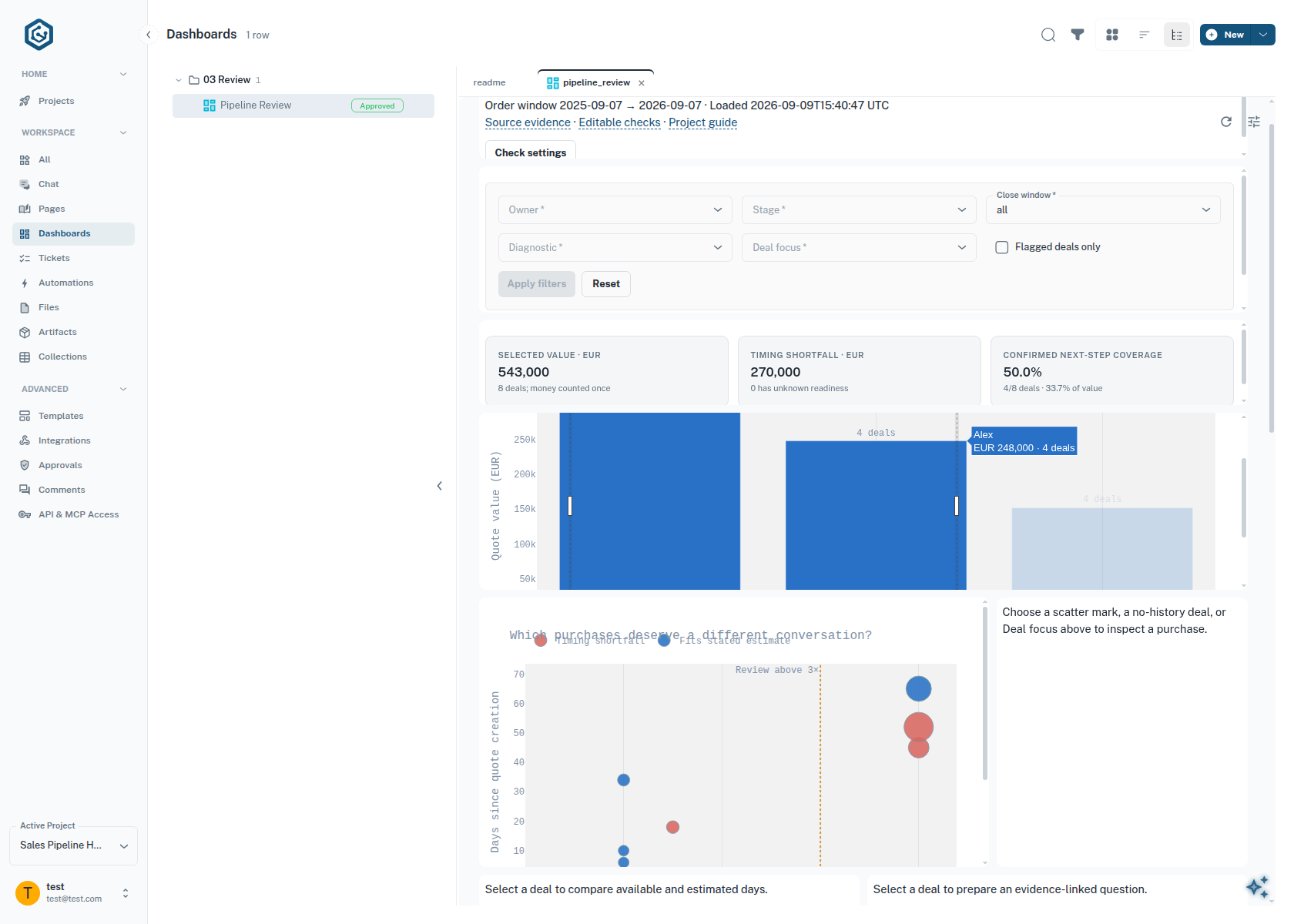
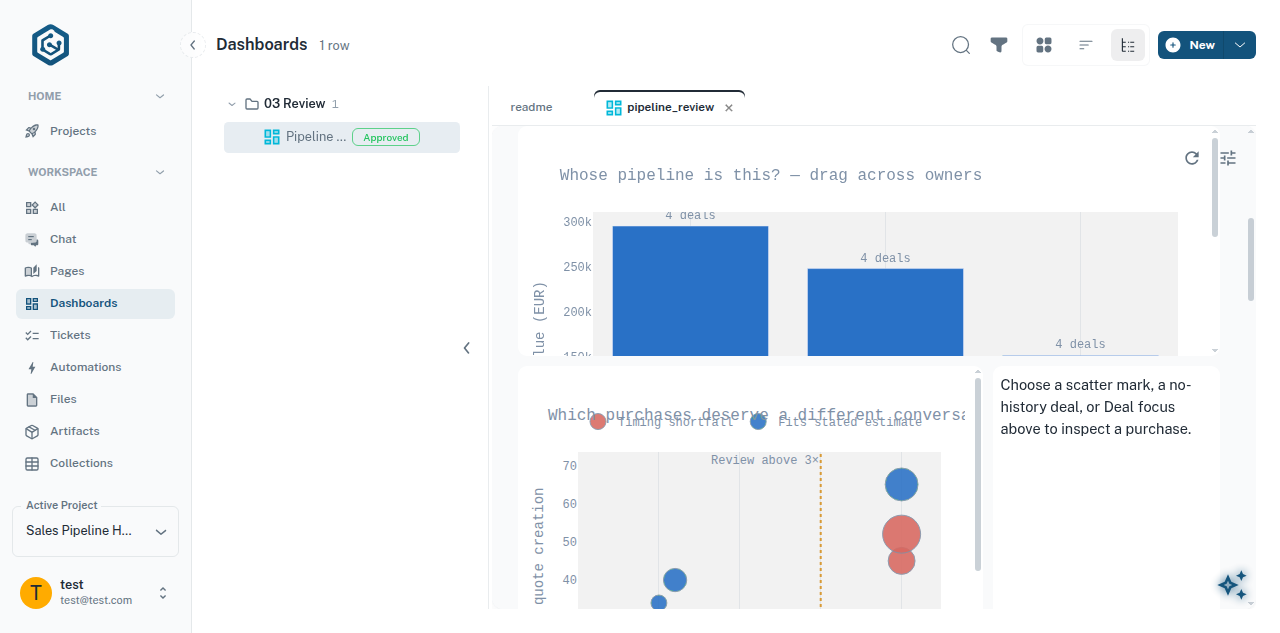
Selecting owners binds every view to the same deals, so the number on the tile and the marks on the chart are the same evidence rather than two reports that disagree. In the review at the top of this page, two owners hold €543,000 across eight quotes; €270,000 of that is scheduled to finish after its own close date, and four of the eight have a next step the buyer has confirmed.
Nothing here is a score. A flag is a calculation with a stated rule and a source you can open, and the review shows the deals it cannot judge as plainly as the ones it can — two quotes carry no close date and no estimate at all.
Scroll to view the full table
| Portfolio measure | Full sample | What it is not |
|---|---|---|
| Quoted value | €695,000 across 12 quotes | Not a forecast, and not a weighted pipeline |
| Flagged value | €523,000 on 7 deals, carrying 14 flags | Not an estimate of value at risk |
| Timing shortfall | €315,000 on 4 deals with negative slack | Not a prediction that those deals slip |
| Unknown readiness | €47,000 on 2 deals with no history and no review row | Absent evidence, not a bad signal |
| Confirmed next step | 5 of 12 deals (41.7%) · €243,000 of €695,000 (35.0%) | Coverage of recorded evidence, not of seller intent |
03Understand the purchase
A familiar customer can be making an unfamiliar purchase.
Compare the open quote against what this customer has actually bought before, and the size of the decision in front of them becomes visible.
Birch has placed eight orders, from €12,000 to €28,000, with a median of €20,000. The open quote is €80,000 — four times that median. Nothing is wrong with the deal. The question the multiple opens is whether a purchase at this scale travels the same approval route as the last eight, and who inside Birch signs for it if it does not.
The comparison declines to answer when it should, which is what makes it worth trusting. Iris has two prior orders, below the three-order minimum, so the review reports insufficient comparison history instead of a multiple. Cedar and Oak have none at all. And a high multiple is not a verdict on its own: Fir is the same 4.0× and has both positive timing slack and a next step its buyer has confirmed.
The deal panel for Birch: eight eligible orders from €12,000 to €28,000 plotted as a distribution, the €80,000 open quote marked against them, the €20,000 median, and the resulting 4.0× purchase-size multiple beside the order count, currency and history window it was computed from.
- 8 eligible orders
- Median €20,000
- Quote €80,000
- 4.0× purchase size
Scroll to view the full table
| Deal | Open quote | Comparable orders | Purchase size | What the review says |
|---|---|---|---|---|
| Birch | €80,000 | 8 orders, median €20,000 | 4.0× | A larger decision than this customer usually makes |
| Fir | €120,000 | 5 orders, median €30,000 | 4.0× | Same multiple, positive slack, confirmed next step |
| Hazel | €45,000 | 4 orders, median €15,000 | 3.0× | Exactly at the threshold, so no purchase-size flag |
| Iris | €90,000 | 2 orders | Insufficient history | Below the three-order minimum to compare |
| Cedar | €35,000 | No order history | Unknown | No comparison and no review row to read |
04Examine the close plan
A close date needs a plan behind it.
Set the business days still available against the days the deal is estimated to need, and the gap stops being a matter of opinion.
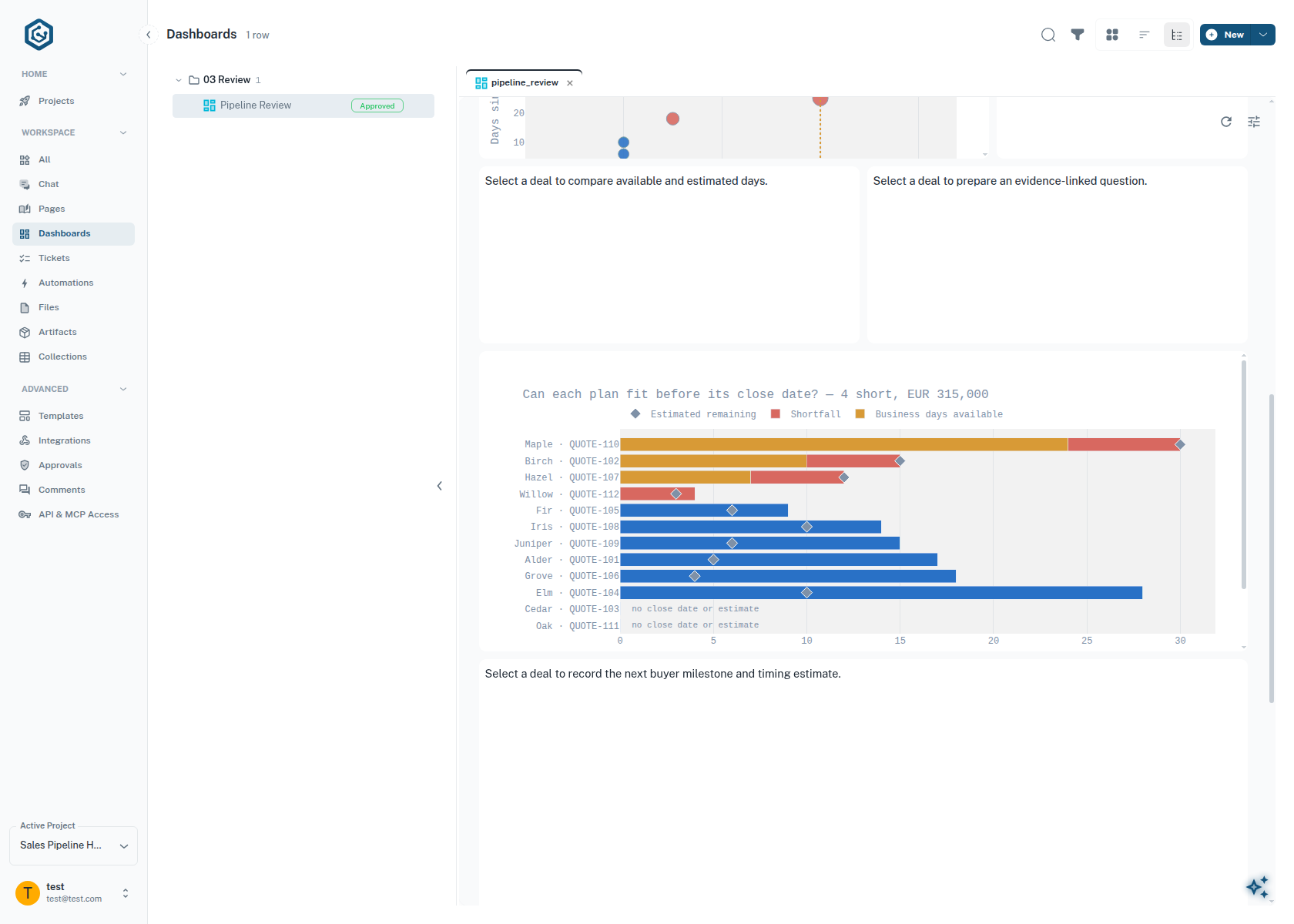
On 7 September, Birch’s 21 September close date leaves 10 business days. Its owner estimates 15 remaining. The slack is −5, and the flag carries the estimate and the note behind it rather than a verdict. The arithmetic is deliberately plain — weekdays between the review date and the close date, minus the owner’s own estimate — and it is stated on the page so anyone can argue with it.
The estimate is editable, and editing it is not the same as changing the deal. Saving 8 days instead of 15 moves the slack to +2 and clears the timing flag — that flag alone. The purchase-size flag stands, and the saved assessment is marked “Evidence changed — refresh assessment.” Nothing about Birch’s procurement got faster; a person revised what they believe, and the review keeps the two apart.
The close-plan panel showing 10 business days available against 15 estimated remaining (slack −5) with the owner’s supporting note, beside the same panel after saving 8 estimated days: slack +2, the timing flag cleared, the purchase-size flag still standing, and the saved assessment marked “Evidence changed — refresh assessment.”
- 10 available
- 15 estimated
- Slack −5
- Edit to 8 → slack +2
- Timing flag clears
Scroll to view the full table
| Deal | Close date | Business days available | Estimated remaining | Slack |
|---|---|---|---|---|
| Birch | 21 September | 10 | 15 | −5 |
| Hazel | 16 September | 7 | 12 | −5 |
| Maple | 9 October | 24 | 30 | −6 |
| Willow | 4 September (past) | −1 | 3 | −4 |
05Prepare a better conversation
Leave the review with the next move, and the evidence for it.
Calculations supply the facts. A requested assessment connects them and proposes a question. A person records what was actually agreed. Those three things stay distinguishable all the way through.
Ask Frontier to assess one deal and it returns observations linked back to the page each came from, the gaps it could not close, and one question worth putting to the buyer. For Birch the facts are the 4.0× purchase size and the −5 slack; the supported inference is that a purchase at this scale may take a different approval route; the gap is that nobody has confirmed what that route is. The question it proposes is of the shape “Who can confirm the approval route and dates for this larger purchase?” — illustrative wording, shown here until the generated text itself is captured.
What gets saved is a person’s work, not the model’s: “Confirm procurement path”, owned by Alex, dated 11 September, with buyer confirmation recorded as assumed. It becomes confirmed when there is evidence for it. A good suggestion does not create buyer agreement, and the record refuses to pretend otherwise.
The assessment output for Birch — observations linked to their source pages, the gaps it could not close and one suggested buyer question — beside the human review form holding “Confirm procurement path”, owner Alex, 11 September, buyer confirmation “assumed”, and the briefing and CSV they export to.
- Request an assessment
- Read observations and gaps
- Record the next step
- Export the briefing
Assessment, on request
One deal at a time, when someone asks for it. Observations, gaps and one suggested buyer question, each linked to the page it came from, with the inputs it read fingerprinted.
A next step someone owns
An action, an owner, a future date and an explicit buyer-confirmation state — assumed until evidence makes it confirmed. Human evidence is kept apart from anything a calculation produced.
A briefing you can send
The selected deals leave as a briefing and a CSV: the facts, the grouped flag reasons, the saved action with its owner and date, and the current assessment where one exists.
06The foundation
Build around the way you sell.
Purchase size and close-plan slack are where this starts, not where it stops. The pages that produce them are ordinary, editable pages in your workspace.
Every flag has a reason, and every rule is a few lines on a page you can open. Move a threshold because your business argues about a different one. Add the check that actually decides your deals. Write a new page entirely: a contribution that emits compatible rows joins the same shared flags, the same linked views and the same review and export as the two shipped with the pack — no second dashboard, no separate export, no copy of the truth.
That is the part worth buying. A capability pack gives a team a working starting point in its own language; the platform underneath is what lets the team keep developing it as the questions change.
Scroll to view the full table
| Layer | What it holds | Yours to change |
|---|---|---|
| Data | Open quotes, order headers and the review rows people maintain by hand | Which population, which currency, which history window |
| Analysis | Editable pages producing quote context, readiness and grouped flag reasons | Thresholds, new checks, whole new pages |
| Review | One shared view, one selection, one set of saved next steps | What the team looks at together, and what it records |
| Handoff | A briefing and a CSV carrying facts, reasons and the owned action | What travels to the people who were not in the room |
Solutions / Sales pipeline intelligence
What should your pipeline be telling you?
Bring us the deals your pipeline review actually argues about. We will work through what Frontier can tell you about them, and what it would take to have it running on your own data.